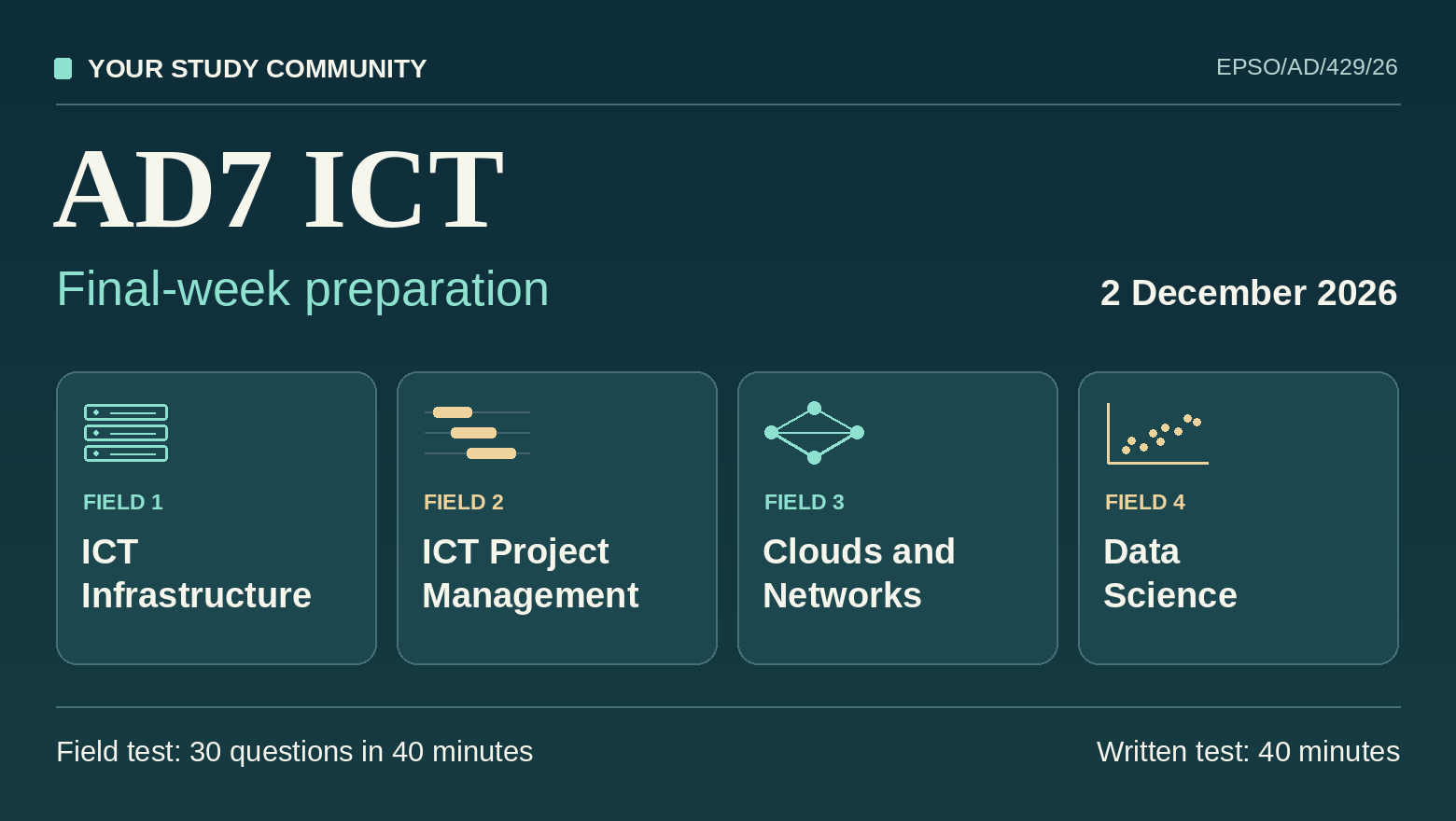
EPSO AD7 ICT 2026: Final-week preparation for all four fields and the Written Test
Choose your AD7 ICT preparation package
| Already confident in Reasoning Skills? Quick Practice · 20 field mock exams · €70 For candidates who consistently pass timed reasoning tests. Choose your ICT field and practise 600 questions with explained answers. Add Written Test preparation · €120 Includes the EUFTE e-book and two individually marked assignments. You can buy it separately. Both purchases together cost €190 (€70 + €120). |
| Preparing for reasoning, your ICT field and the Written Test? BASIC Complete · €300 Includes the Reasoning Skills e-book and 50 mocks, your field e-book and 20 specialist mocks, plus the Written Test e-book and two individually marked assignments. |
Available in all 24 official EU languages. The free sample below is in English. Contact Your Study Community before ordering if your language is missing at checkout.
With the AD7 ICT tests scheduled for 2 December 2026, start with the result of your latest timed reasoning mock. If you consistently pass verbal reasoning and the combined numerical and abstract tests, spend most of your remaining practice time on your chosen ICT field and the Written Test (EUFTE). Your field score determines your ranking among candidates who meet the relevant thresholds. The written test has its own pass mark. Check your invitation for your individual testing arrangements. EPSO testing timetable · Official competition notice
Download the free EUFTE sample (PDF, 7 pages)
Two writing tasks, model answers and a marked-up draft.
What to practise under timed conditions
| Test | Exam format | Score to keep in mind |
|---|---|---|
| Verbal reasoning | 20 questions in 35 minutes, Language 1 | 10/20 |
| Numerical and abstract reasoning | Numerical: 10 in 20 minutes. Abstract: 10 in 10 minutes. Both in Language 1. | 10/20 combined |
| Field-related MCQs | 30 questions in 40 minutes, Language 2 | 15/30 minimum. Candidates are ranked by field score. |
| Written Test (EUFTE) | 40 minutes, Language 2 | 5/10 |
For the field test, 40 minutes allows an average of 80 seconds per question. After a timed set, revisit the questions where two answers seemed equally plausible. Which detail in the scenario favoured one of them? The four original practice cases below illustrate that decision in each specialty. Use the section for the field you selected in your application. Test rules in section 4.3 and field duties in Annex II
Field 1 · ICT Infrastructure
Practise decisions about storage, backup, virtualisation, high availability and service operations. For a recovery exercise, draw a timeline with three points: the disruption, the latest transaction recovered and the moment users regain the service. Each timestamp answers a different question.
Try it. A payroll service goes down at 10:00. Its recovery time objective is 60 minutes and its recovery point objective allows up to 15 minutes of lost data. The database is online at 10:45, but staff can resume processing payments only at 11:10. The last recovered transaction is from 09:50. Which objectives did the service meet?
Answer. It met the recovery point objective only. Ten minutes of data were lost, within the 15-minute limit. Staff waited 70 minutes to resume processing, exceeding the recovery time objective by 10 minutes. The tempting answer is “both” if you stop the clock when the database comes online. The stated objective applies to the payroll service that staff use.
Field 2 · ICT Project Management
Review changes to scope, budget and schedule alongside procurement, risk, quality assurance and acceptance. For each scenario, identify who owns the decision, what has already been approved and what still needs evidence. Those details matter when two otherwise reasonable actions appear in the same question.
Try it. A supplier can deliver a case-management system on time if a reporting feature moves to the next release. The feature is in the approved acceptance criteria. The sponsor supports the idea, but the project board has sole authority to change scope. What should the project manager do before accepting the release?
Answer. Document the proposed change with its effect on users, schedule, cost and acceptance criteria. Take it to the board for a decision before accepting the revised scope. The sponsor’s support helps the proposal, but only the board can approve it in this scenario. Recording the omission as a defect would also leave unresolved whether the original requirement still applies.
Field 3 · Clouds and Networks
Revise hybrid connectivity, private endpoints, DNS, routing, load balancing and cloud service availability. Follow one user request from its starting network to its destination. A healthy cloud service can still be unreachable from a particular office.
Try it. After a migration to a private endpoint, users in the cloud can open an internal application. Branch users cannot. From a branch, a test using the correct service name with its private address supplied manually succeeds. A normal lookup at the branch still returns the old public address. Which check comes first?
Answer. Check how the branch DNS resolver handles the application’s domain, including any cached record and the forwarding path to the private DNS zone. The controlled test shows that the branch can reach the application at its private address while preserving the correct service name. Increasing bandwidth or scaling the application would leave the conflicting DNS answer in place.
Field 4 · Data Science
Review the full path from raw data to a decision: ingestion, data quality, feature construction, validation and monitoring. In a model-evaluation question, write down the exact time at which the prediction must be made. Then ask what information actually existed at that moment.
Try it. A unit wants to predict at registration whether a case will miss its deadline. Historical data contain the final number of reminders issued before closure. A model using this variable scores well on a random split. A colleague proposes keeping the variable and testing on the most recent quarter. Would that fix the evaluation?
Answer. A later test period is useful, but the final reminder count still contains information from after registration. Rebuild each historical record using only information available when it was registered. Train on earlier cases and evaluate on a later period with known outcomes. The new score then answers the operational question: how well can the unit predict delay when a case first arrives?
The Written Test (EUFTE) for all four fields
EPSO has published the same source document for all four specialties: Regulation (EU, Euratom) 2023/2841 on cybersecurity in EU institutions and other Union entities. In the 40-minute test you receive a specific assignment and have access to the source. EPSO assesses written communication. When you practise, identify the reader and the task before choosing which details to use. Read the official instructions and source in your test language
Free Written Test sample
Practise with two drafting assignments, compare your work with the model answers and follow five tutor corrections to a third script.
Download the free Written Test sample (PDF, 7 pages)
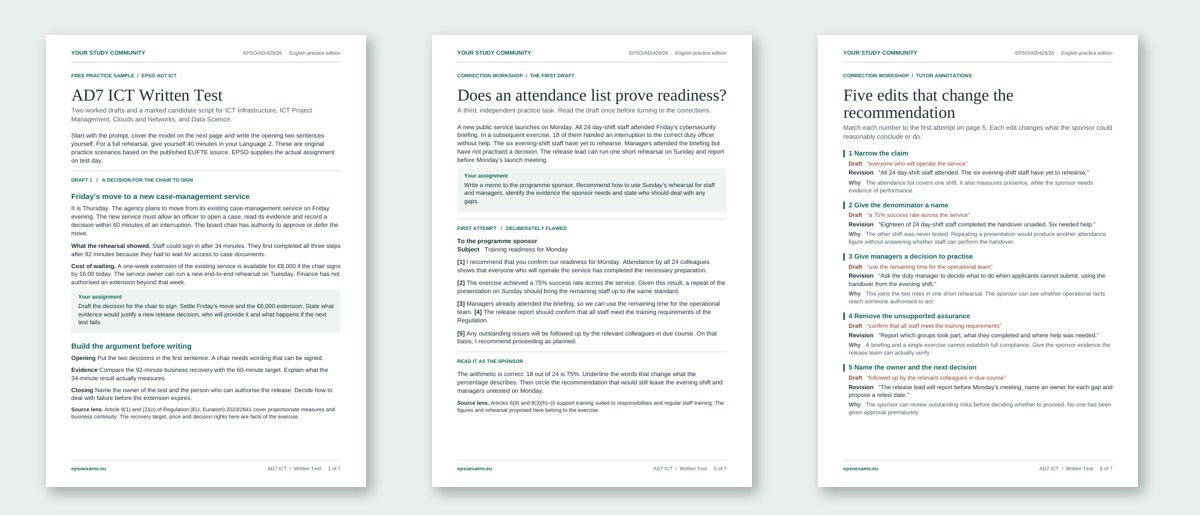
English practice sample · Cybersecurity training before a service launch
Adapted from assignment 11 of the Your Study Community ICT Project Management handbook (pp. 40–41).
Your task. The project team plans to give everyone the same cybersecurity presentation before a new service goes live. Write a short memo to the programme sponsor. Recommend what managers and operational staff should practise, and how the sponsor can judge whether they are ready.
Model memo to the programme sponsor
Decision requested on staff training before launch
Please approve a short rehearsal after the common staff briefing. The Regulation calls for regular cybersecurity training. A rehearsal would let us check whether people can carry out their own responsibilities when a service is interrupted.
Give the duty team and the manager the same scenario: staff can open the new service, but users cannot submit applications. Ask the duty team to brief the incoming shift on who is affected and how to reach the local cybersecurity officer. Give that handover to the manager and ask what action they would authorise and what information they still need.
Before launch, ask the release lead for a one-page record of any missed handovers or delayed decisions. Assign an owner to each gap and repeat that part of the rehearsal with the deputy on duty.
Tutor feedback. “Everyone attended” tells the sponsor who was present. “The incoming shift could identify the affected users and contact the duty officer” tells the sponsor what staff could do. The closing paragraph gives the sponsor evidence on which to base a decision.
A seven-day plan for 25 November to 1 December
| When | What to do |
|---|---|
| 25–26 November | Complete one field mock in Language 2. Review every error and guessed answer. Pick the two topics that cost you the most marks and revisit the relevant material. |
| 27–28 November | Practise those two topics, then take a fresh mixed set. Read the EUFTE source and draft one response in 40 minutes. As a practice split, allow 5 minutes to plan, 30 to write and 5 to edit. |
| 29–30 November | Take another full field mock. Compare repeated errors across attempts. Rewrite the weakest paragraph of your first written response, then try a second assignment for a different reader. |
| 1 December | Review your recurring errors. If a reasoning score is still close to the threshold, do a short timed set in that area. Check the instructions and connection details in your candidate invitation. |
Your Study Community provides independent preparation for EPSO competitions. The field cases and sample memo are independent practice material from Your Study Community.